I consider the past year to be a musical success at Northwest Unitarian Universalist Congregation. The choir sounded good, the new contemporary band was a big hit, and we were successful in resolving some long running issues with the sound system.
Not everything went according to plan. My biggest challenge was in starting a children's choir. I think there were two main reasons for the difficulty: scheduling and lack of a tradition.
At the beginning of the church year, I scheduled a children's choir rehearsal every other week at 12:30, after Second Hour. We had service at 10, Second Hour (classes) at 11:20, and then children's choir at 12:30. In theory, this seemed like a good idea. In practice, it didn't work out so well. By the time 12:30 rolled around, everyone was hungry and ready to go home. On top of that, we occasionally had a church wide event that overrode children's choir, such as a congregational meeting or a potluck.
With no established children's choir in Northwest's recent history, it was more difficult to start one than I anticipated. Part of my goal was to simply show the kids what it was like to be in a choir. That was hard to do when we sometimes had rehearsals with only 2-3 singers.
Now that this first year is done, I'm rethinking children's music at Northwest. I still think it's important to have the children participate in the musical life of our congregation. I've decided that, if the kids can't come to me, I'll go to them. Rather than have a regular children's choir, I'll go into the classrooms 1-2 times a month after the main service and sing songs with the kids. Also, and this isn't set in stone yet, we have been thinking about holding a kid friendly mini-service in the chapel maybe once a month. I'll plan on being part of that service as a song leader. Every so often, we'll hold a special rehearsal with the children, in which they'll prepare to sing their favorite songs for the main Sunday service. I think we'll have more success in getting good attendance if we hold a special dress rehearsal every so often instead of an every other week schedule.
There will still be a children's program next year. It'll just be less formal than I originally envisioned. I still would like to have a children's choir at Northwest, but we'll do this first. One step at a time.
About Me

- Tom Godfrey
- Atlanta, GA, United States
- When I suffered a lip injury that ended my career as a classical trombonist, I thought my life as a musician was finished, but I fell in love with music all over again when Santa gave me a guitar for Christmas in 2003. Even as I was struggling with my first chords, I was planning a new performance career. As a trombonist, I performed with the Heritage of America Band at Langley Air Force Base, the Ohio Light Opera, and in pick-up bands for touring acts that included Rosemary Clooney, George Burns, and the Manhattan Transfer. Reborn as a jazz guitarist, I sing and play my own solo arrangements of jazz classics, am half of the Godfrey and Guy duo, and hold the guitar chair in the Sentimental Journey Orchestra. I have been a freelance music copyist since 1995, served as Director of Music at Northwest Unitarian Universalist Congregation from 2011 to 2017, and currently serve as Contemporary Band Director at the same congregation.
Thursday, June 19, 2014


Monday, June 16, 2014
Classical and Jazz Guitar


While jazz guitar often feels like a moving target, classical guitar feels more stationary. You can always play more cleanly or with a difference nuance, but you at least know which notes you supposed to play. In general, there's little, if any, improvisation with classical guitar. If jazz guitar is like a free flowing conversation, then classical guitar is like the script of a play.
I've heard jazz guitarists disparage classical guitar, saying that it feels like paint by numbers, but that's not what it feels like to me. Even the limited selection of classical music that I'm able to tackle is gorgeous, and it fits in quite well with my mellow style of playing. I'm glad for this gig, because it has rekindled my love of classical guitar. I'll never be mistaken for a real classical guitarist, but I think I'll keep this music in my repertoire after the gig is over.
Thursday, June 12, 2014
Year Three

When I first started the job, I was frankly happy to have a steady source of income, even if it was only a quarter time position. While I enjoyed being with the people at Northwest, I have to admit that I looked on it as a steady gig. I felt that my job was to come in twice a week, do my "music thing," and then make myself scarce. I felt that the music program was a separate entity – a self contained little bubble within Northwest.
That sense of separation began to dissolve in my second year, when Terry Davis became our minister. She brought a sense of inclusiveness, openness, and energy that had been lacking. Music became more integrated into the Northwest experience as Terry consulted with the staff to plan services. I began to become more than "the music guy." I was playing my part in a supportive team. Terry also helped me realize the impact that my role has on the church, and in particular on the choir members. Being a secular humanist, I had never thought that my music program was a ministry, but I learned otherwise. (And for those of you who are wondering how a godless heathen such as myself could be a music director at a church, I invite you to visit www.uua.org and read up on Unitarian Universalism.)
It wasn't until this past year that I began to feel like I was, indeed, the actual Director of Music at Northwest UUC. It began to feel real. For the first two years, I felt like my job was to keep a steady hand on the wheel and keep the music going through some staff changes (new music director the first year, new minister the second year). In this third year, I began to put my own stamp on the music program, most notably with the launching of a contemporary band. This band, which has yet to be named, was a popular addition right from the start, and then it kept getting better and better. Also, after struggling with sound issues for years, we finally managed to update our sound system, thanks in large part to the expertise of Bob Bakert, who is not a member of Northwest, but hosts the Hungry Ear Coffee House show that Northwest puts on every month.
Even where I have met challenges, I feel like I'm growing into my role. I had some difficulty starting a children's choir this year. (More on children's choir in a future article.) Even where I have faltered, I have continued to enjoy the support of the staff and the congregation. Rather than giving up on a children's music program because of a rocky first year, they have offered advice and support, and we have a new plan for children's music in the coming church year.
As each year passes, I am more and more grateful for this job. It started off as a gig, but it has become so much more.
Monday, June 9, 2014
Lesson Recap 6/9/14
I just returned from a good jazz guitar lesson with Dave Frackenpohl at GSU. I was ultra-prepared for this one. I wish I could say that about every lesson.
Dave gave me a lot to work on for this lesson, which included:
Dave gave me a lot to work on for this lesson, which included:
- Satin Doll: 3-note comping exercise. This was pretty simple, and it was a good warm-up. These 3-note voicings are a good reminder that there is power in simplicity. I don't have to try to play every note of every chord. Even in a setting where the guitar is the only instrument, simple 3-note voicings often sound best.
- Joy Spring: This is a workout! The melody is challenging on guitar (at least for me), and the chords are a little tricky to improvise over (at least for me), but I love this tune. It sounds so happy! Dave clued me into a simple Coltrane approach for when the chords come at you two to a bar. If you can't think of anything else to do, it's quite effective to outline the chords with a 1-2-3-5 pattern. That's an idea I'll be incorporating into other songs. Next assignment: Continue this song to build speed and work out some 1-2-3-5 Coltrane patterns.
- Body and Soul: I did pretty well at this playing in the key in which I sing it (Bb). I've been singing it in this key so long that I had forgotten that the stock key is Db. Next assignment: Learn it in Db.
- Bernie's Tune: This is a fairly easy song to learn, but it highlights my lack of dexterity. I can play pretty stuff all day long, but my fingers aren't very nimble. Next assignment: Dave gave me some scale patterns to practice. Over the D minor, I'll be practicing a D dorian bebop scale, and over the Bb7, I'll be practicing F dorian bebop and F melodic minor. It'll sound like mindless scale practice for a while, but it'll help speed up my technique.
- Saint Thomas: I transcribed the classic Jim Hall solo, from his duet with Ron Carter. Aside from being a terrific solo, this is a great exercise in using voicings with octaves and 6ths. Next assignment: Memorize the solo and work it up to speed.
In addition to the assignments listed above, I am to memorize Angel Eyes, Bésame Mucho, and Song for My Father.
Despite playing well today, most of my next assignment is a reassignment of the tunes I just played, but I don't mind. In repeating these songs, Dave is prodding me to dig deeper into the music and improve my technique. The work I put into these songs directly affects my understanding of the rest of my repertoire. I'm looking forward to further exploration in a couple weeks.
Sunday, June 8, 2014
Traveler Acoustic
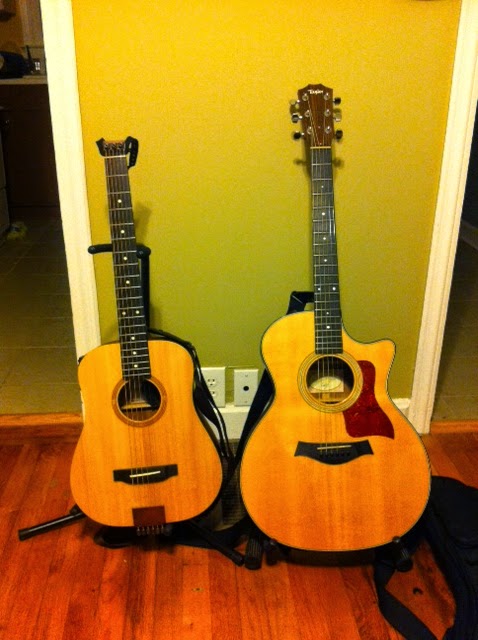
Traveler Guitar makes a variety of travel sized guitars, both electrics and acoustics. I liked the idea of an acoustic for the simplicity of not having to plug it in to practice. Plus, I simply prefer acoustic over electric sounds these days.
In the photo, I put the Traveler next to my Taylor for comparison. One thing I love about the Traveler is that it has a full scale, 25.5" neck. Even though it doesn't have a cutaway like the Taylor, I can more easily reach higher notes on the Traveler. You can't see it very well in the photo, but the tuners are on the end of the strings by the body of the guitar. It also has a pick-up, so I could plug in and use it as back-up guitar if the need arose. The Traveler's tone is decent, but with such a small body, the guitar lacks a depth of sound. It doesn't even compare to the Taylor, which has the most beautiful sound of any guitar I've owned, including a gorgeous Heritage 575 that I still play.
But I didn't buy the Travel for the tone. I bought it for portability. I'll be taking it to the UUMN conference in July, and it'll replace the guitar I currently use for teaching. And the Travel has one thing the Taylor doesn't: a strap on the end so you can hang it on a hook. Bonus points for cuteness.
Saturday, June 7, 2014
Memorizing
A lot has happened since last I wrote. I'll see what I can do about getting caught up on this blog. The latest and greatest happening is that my duo, Godfrey and Guy, landed a regular gig at Noosh Persian Bistro. It's a wonderful gig! We play at this lovely place every Friday from 7-10 (more about Noosh in another article).
One of the nicest things about a steady gig is the luxury of playing through your repertoire on a regular basis. We have been rehearsing weekly for 2.5 years. Without a regular gig, we spent a lot of time reviewing songs we had already learned. Now, we can review our songs at the gig, and we can spend our weekly rehearsal time learning new songs or shoring up our weaker numbers.
For the past couple months, I've been spending a lot of time memorizing Godfrey and Guy songs. We have more than 100 songs in the book, and we add a handful of new ones each month. That's a lot of music to memorize. My goal is to memorize them all. I estimate that we burn through at least 40 songs each Friday. Someday, I hope to play a gig at Noosh without cracking open our book.
There are two main reasons I am memorizing our music. First, it's easier to gain rapport with an audience if you don't have the music in front of you. Instead of staring at the music stand, you can make eye contact with the audience. Second, when I've memorized a song, I feel a deeper connection with it. If a song is memorized, I play it with more presence and command.
The weekly repetition helps me keep these songs in my head. We can't play through all of our music in one night, but there are few songs we play every week. I also find that challenging my memory is like exercising a muscle. The more time I spend memorizing, the easier it becomes.
Finally, there is so much music to memorize that it could easily become overwhelming. I've found that the best approach is to memorize 1-2 songs each week, cycle through the other songs I've already memorized, and then challenge myself to play those songs from memory on the gig. Like anything else worth doing, it's a gradual process.
One of the nicest things about a steady gig is the luxury of playing through your repertoire on a regular basis. We have been rehearsing weekly for 2.5 years. Without a regular gig, we spent a lot of time reviewing songs we had already learned. Now, we can review our songs at the gig, and we can spend our weekly rehearsal time learning new songs or shoring up our weaker numbers.
For the past couple months, I've been spending a lot of time memorizing Godfrey and Guy songs. We have more than 100 songs in the book, and we add a handful of new ones each month. That's a lot of music to memorize. My goal is to memorize them all. I estimate that we burn through at least 40 songs each Friday. Someday, I hope to play a gig at Noosh without cracking open our book.
There are two main reasons I am memorizing our music. First, it's easier to gain rapport with an audience if you don't have the music in front of you. Instead of staring at the music stand, you can make eye contact with the audience. Second, when I've memorized a song, I feel a deeper connection with it. If a song is memorized, I play it with more presence and command.
The weekly repetition helps me keep these songs in my head. We can't play through all of our music in one night, but there are few songs we play every week. I also find that challenging my memory is like exercising a muscle. The more time I spend memorizing, the easier it becomes.
Finally, there is so much music to memorize that it could easily become overwhelming. I've found that the best approach is to memorize 1-2 songs each week, cycle through the other songs I've already memorized, and then challenge myself to play those songs from memory on the gig. Like anything else worth doing, it's a gradual process.
Tuesday, March 4, 2014
Rockin' Oakhurst Elementary
I just returned from an important 8:30 a.m. gig with a 6.5 year old student name Bennett. Bennett was assigned to give a black history presentation to his 1st grade class. He gave his presentation on Stevie Wonder. Bennett loves Stevie Wonder. (I think it is evidence of good parenting.) His teacher knows that Bennett is taking guitar lessons, so she suggested that he perform a Stevie Wonder song at the end of his presentation. Bennett and I decided on Ebony and Ivory, which is actually a Paul McCartney song that he and Stevie Wonder recorded as a duo.
To prepare for this performance, I copied out the first 8 bars of Ebony and Ivory, which can be easily played with just two chords. In working on the song, Bennett learned how to play a Dmaj7 chord and how to use a capo, which he placed on the second fret to match the key of the recording. (The actual chords alternate between Emaj7 and F# minor. With the capo, Bennett alternated between Dmaj7 and E minor.) We practiced the song for two lessons, worked up a nice little arrangement, and then I met up with Bennett's parents this morning for the big show.
When we walked into the classroom, Bennett looked forlorn. He was already standing in front of the class with all his classmates seated in a circle around him. By the look on his face, you'd have thought he was being offered up as a sacrifice. There was a great show of relief on his face when he saw his parents and his guitar teacher walk through the door.
Bennett had certainly done his research and knew his stuff, although he needs to work on his delivery. He had made a large poster with all sorts of Stevie Wonder facts, and he kept his back to the class as he read from the poster. His mom, who was recording a video, pretty much got a video of Bennett's back for about 10 minutes of presentation.
When Bennett said something about Ebony and Ivory, I knew that was my cue. Like any good guitar tech to the stars, I had already tuned his guitar and added his capo. We sat down and began playing. Bennett nailed it! I couldn't have been happier with his performance. He got a big cheer at the end, and then some of his friends asked for his autograph after his presentation. Sadly, no one asked for my autograph.
This morning was a big deal for Bennet, but it was a treat for me, too. I was so proud of how he played of his presentation in general. It was a lot of fun to put his guitar lessons to use in a real world setting. Bennett sometimes asks me when he's going to be a good guitar player. As far as I'm concerned, considering he's only 6 years old and has been playing for a year (maybe less), Bennett is already good. He has a good sense of rhythm and sings on pitch (when I can get him to sing). He didn't miss a beat today. Most importantly, he's excited and curious about the guitar. If he keeps on practicing, his natural talent and enthusiasm will take him far.
 |
| Nailing a Dmaj7 |
When we walked into the classroom, Bennett looked forlorn. He was already standing in front of the class with all his classmates seated in a circle around him. By the look on his face, you'd have thought he was being offered up as a sacrifice. There was a great show of relief on his face when he saw his parents and his guitar teacher walk through the door.
Bennett had certainly done his research and knew his stuff, although he needs to work on his delivery. He had made a large poster with all sorts of Stevie Wonder facts, and he kept his back to the class as he read from the poster. His mom, who was recording a video, pretty much got a video of Bennett's back for about 10 minutes of presentation.
When Bennett said something about Ebony and Ivory, I knew that was my cue. Like any good guitar tech to the stars, I had already tuned his guitar and added his capo. We sat down and began playing. Bennett nailed it! I couldn't have been happier with his performance. He got a big cheer at the end, and then some of his friends asked for his autograph after his presentation. Sadly, no one asked for my autograph.
 |
| Proud Parents |
Subscribe to:
Posts (Atom)