Every morning, I spend about 20 minutes playing scales and arpeggios to warm up my fingers. Guitar is a little different from most instruments in that there are several ways to play any given scale. For example, on the piano, there is only one middle C. On the guitar, there are several middle C's sprinkled around the fretboard. Similarly, there are several different fingerings for a C major scale on the guitar, depending on where you start on the neck. I use 5 basic patterns to play any given scale. If I were to play all my scales and arpeggios in all 12 keys, I'd be worn out by the time I finished warming up, so I warm up in a different key every day, moving my way through the circle of 4ths. Today happened to be my "C" day. It'll be F tomorrow and B-flat the next day, etc.
I recently began to apply this "key of the day" concept to I Got Rhythm, by George and Ira Gershwin. The melody isn't the most fascinating string of notes you'll ever hear, but the chord changes are extremely important in the jazz world. There are many variations on "Rhythm changes," and there are several tunes based on Rhythm changes. (By the way, a new melody written over a set of chord changes to a previously written song is called a contrafaction. Now you know.)
Since I play my warm-ups in a different key every day, I've also begun playing I Got Rhythm in the key of the day. I'll play the melody, play the chord changes, outline the chord changes as arpeggios, and then improvise. When I began this little adventure, the key of the day was G-flat, so it got off to a slow start!
I'm already finding this to be a tremendously valuable exercise. My transposition skills are improving. The song is filled with ii7-V7 progressions to work through. Some keys force me to find licks in chord shapes in which I'm less than comfortable. Just as with scales and arpeggios, I plan on working through Rhythm changes for a long, long, long time.
About Me

- Tom Godfrey
- Atlanta, GA, United States
- When I suffered a lip injury that ended my career as a classical trombonist, I thought my life as a musician was finished, but I fell in love with music all over again when Santa gave me a guitar for Christmas in 2003. Even as I was struggling with my first chords, I was planning a new performance career. As a trombonist, I performed with the Heritage of America Band at Langley Air Force Base, the Ohio Light Opera, and in pick-up bands for touring acts that included Rosemary Clooney, George Burns, and the Manhattan Transfer. Reborn as a jazz guitarist, I sing and play my own solo arrangements of jazz classics, am half of the Godfrey and Guy duo, and hold the guitar chair in the Sentimental Journey Orchestra. I have been a freelance music copyist since 1995, served as Director of Music at Northwest Unitarian Universalist Congregation from 2011 to 2017, and currently serve as Contemporary Band Director at the same congregation.
Monday, January 27, 2014


Monday, December 30, 2013
2014 Goals
In my last blog article, I outlined my goals for the next 10 years. In support of those long range goals, here are my goals for 2014. I have some other, smaller goals, but these are the main ones.

Weigh 195 pounds. I feel like my weight is finally (finally!) under control. I've been maintaining about the same weight since September. This year, I plan to make a final push and get it down to a healthy 195 pounds. My strength is improving, my resting heart rate is nice and low (in the 50s), and I feel good in general. While I am feeling quite healthy, I would like to actually look like I work out. I've been going to the gym regularly to add strength training to my cardio work. I'll continue to do that, and I'll tighten up my diet a bit.

Maintain a roster of at least 20 guitar or ukulele students. My long range goal is to have 30 students, but if I added so many students all at once, I wouldn't be able to handle the schedule and still juggle my other responsibilities. I have 13 students now, so I need to add 7 more to meet my goal. I generally add only one student each month, but I have a pretty good retention rate. I'll just keep building my roster slowly.
Add another event planner to my list of regular clients. I finally managed to get my foot in the door with a good event planner. I'm hoping that having one major event planner as a client will make me more attractive to others.

Become more comfortable with unaccompanied guitar improvisation. One of my long range goals is to improvise comfortably in the style of Joe Pass. I've been improving in this area, but I have a long way to go. I've been approaching this skill haphazardly, improvising unaccompanied on random songs. This year, I'm going to focus on a handful of songs and get really comfortable with them. Through my lessons with Dave Frackenpohl, I've learned that I can make good progress on improvisation in general if I focus intensely on one or two songs at a time.
Sunday, December 29, 2013
The Next 10 Years

When I decided I was going to become a professional guitarist, I drew up a list of goals for the first 10 years. My overall goal was to become an "entry level" professional. To me, this meant attaining a skill level that was high enough that I could do a good job at gigs. It also meant that, while I wouldn't necessarily be the first call player in Atlanta, I would develop enough connections to keep me gigging on a fairly regular basis.
I'm rarely satisfied with my playing, but I would like to pause for a moment and be grateful that I met my 10 year goal. I'm not a world beater on guitar, but I'm pretty good. I sight-read extremely well. I gig steadily.
Okay, the moment is over, and it's time to look at the next 10 years. This is my overall goal: To become a well established freelance musician making a comfortable living as a performer, teacher, and church musician.
That's a pretty broad goal. Maybe it's more of a mission statement, but it can be broken down into several goals. To be a well established performer implies an increasingly higher level of musicianship, so the most important goals to me are in the area of musical development.
These are my goals for 2024:
- Play an average of 2-3 good paying gigs per week.
- Maintain a roster of 30 students.
- Increase the NWUUC Music Director job to 20 hours per week.
- Memorize 100+ jazz standards.
- Comfortably improvise guitar solos in the style of Joe Pass.
- Become a good scat singer.
- Become a competent piano player.
- Become a competent ukulele player.
- Be financially stable enough to take 1-2 yearly vacations.
- Live in a rented house, big enough for a studio space, in a quiet, safe neighborhood.
- Comfortably maintain a healthy weight of 190-200 pounds.
Having all these goals without devising a way to meet them is no good. I've broken each of these goals down into separate steps, but I won't include them here, otherwise, this would be a really, really long article. I'll break down a few choice goals into steps in future articles.
Getting this far was a blast. It was 10 years well spent. Time to get busy and make the next 10 years even better.
Wednesday, December 25, 2013
Christmas Lullaby
I enjoyed a special Christmas treat when my mom sang Peggy Lee's Christmas Lullaby with me in last night's Christmas Eve service at NWUUC.
Let's backtrack.
When I was a kid, Mom was a professional musician, singing folk songs and strumming her guitar at public and private events. For public shows, Mom and Dad would take my brother (Darren), my sister (Cheree), and me along. Darren and I would often perform a handful of numbers with Mom. Dad would run the sound system. Cheree was too young to sing with us, but she would dance in Mom's guitar case and keep us all entertained. (Our parents took us to gigs to perform, but I imagine another reason they took us was so they wouldn't have to spring for a babysitter.)
Those performances were special times. Looking back, we weren't exactly playing in huge venues. We were on the mall circuit, and we would often play at local churches and small festivals, but that was big time for us kids. I felt like a star! I'm mainly a jazz musician, but I still have a deep love of folk music that can only stem from this treasured childhood experience.
Mom has been visiting for the past few days and has heard me practicing Christmas Lullaby over and over, so she learned the song by osmosis. We arrived at church early so I could make sure the sound system was set up. After a quick soundcheck, I ran through the Christmas Lullaby and heard Mom harmonizing. She sounded pretty, so I asked her if she wanted to sing it with during the service. Mom immediately agreed. We sang through it a couple more times and were good to go. She sounded great in the service. It was a real treat to sing with her.

Monday, December 9, 2013
Tick Tick
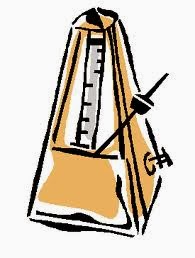
We had a good laugh today when she said, "The metronome messes me up."
This may sound like a remedial exercise, and I know for certain that my student doesn't enjoy this, but it's absolutely essential to develop a sense of rhythm and time. It's the only way you're going to play well with others. Even if you're a soloist, you're going to need to keep a steady beat, otherwise people will find it challenging to listen to you.
Whether you want to be a killer lead player or a rock solid rhythm player, practicing with a metronome is the most efficient way to improve your technique. Once you are able to maintain a steady beat and stay in sync with the metronome, you can make friends with difficult lines or chord changes more easily. First, you start the metronome at a tempo at which it is nearly impossible to make a mistake. It may be an excruciatingly slow tempo, but that's okay. You want to start super slow, so that you are properly training your muscle memory. Get it right in slow motion, and you can then incrementally get it right at speed. Just start at a nice, easy tempo. Practice a problem area until you can play it correctly. Increase the metronome speed by 5 clicks and repeat the process. You will eventually run into a speed at which your technique finally breaks down. Remember the top speed at which you could play with control. The next time you practice that spot, start 10-20 clicks slower than your top speed and build from there. It won't be long before you can sail through that lick or those tricky chord changes.
My student has told me that she has no rhythm. I beg to differ. She has an undeveloped sense of rhythm, but it's in her. All she needs is a metronome and a few minutes a day focusing specifically on tempo.
Monday, November 18, 2013
Ripples

Early in the short history of the Zen Tea Jam, a trumpet player showed up a couple times. Then he stopped coming. He always seemed to have a conflict. I didn't think anything of it and assumed that he had lost interest.
That trumpet player called me today, asking for some music theory help. It turns out that, even though he wasn't able to participate in the jam session, his love for music was reignited, and he decided to get back to playing trumpet regularly. He is joining a band. He told me that some of his friends used to play in their school jazz band or concert band. They talk about how much they miss it, but they don't pick up their instruments. I was genuinely pleased for him. I congratulated him, telling him that a lot of people miss playing an instrument, but they don't do anything about it. He, on the other hand, is picking up his horn and joining a band.
This trumpet player was inspired to get back into playing. That would be beautiful enough, but I like to think that his example will inspire some of his friends to start playing again. Maybe their children will be encouraged to pick up an instrument. Maybe this short lived jam session had a ripple effect. I hope so.
Thursday, November 14, 2013
Lesson #16
This is a recap of my latest jazz guitar lesson with Dave Frackenpohl, who teaches at Georgia State University. This helps me wrap my head around the new assignment, and I hope it also helps others who may be on the same path.
We started with a series of 7th chord arpeggios over the melodic minor scale…1 going up, 2 down, 3 up, etc., and then working our way back down. Dave showed me a more useful fingering for a form that starts on the 6th string, but otherwise, these went pretty smoothly. Then we played through Four. He showed me some different chords to use in the B sections. I've been starting the B section on an E-flat, but Dave told me that it's more common to start on G minor. Next, we moved on to Old Devil Moon. I mainly wanted to work on this so that I could work up a good accompaniment and a chord melody solo. Dave was pleased with the chord melody solo, but noticed that I tended to rush the B section, when I switch from Latin to swing. He also questioned the lead sheet and asked me to double check other sources for the melody and changes in the last 4 measures. Finally, we started looking at When Sunny Gets Blue for the next lesson assignment.
The new assignment:
We started with a series of 7th chord arpeggios over the melodic minor scale…1 going up, 2 down, 3 up, etc., and then working our way back down. Dave showed me a more useful fingering for a form that starts on the 6th string, but otherwise, these went pretty smoothly. Then we played through Four. He showed me some different chords to use in the B sections. I've been starting the B section on an E-flat, but Dave told me that it's more common to start on G minor. Next, we moved on to Old Devil Moon. I mainly wanted to work on this so that I could work up a good accompaniment and a chord melody solo. Dave was pleased with the chord melody solo, but noticed that I tended to rush the B section, when I switch from Latin to swing. He also questioned the lead sheet and asked me to double check other sources for the melody and changes in the last 4 measures. Finally, we started looking at When Sunny Gets Blue for the next lesson assignment.
The new assignment:
- Continue Diatonic Arpeggios. I've worked on a series of 7th chord arpeggios over the major, harmonic minor, and melodic minor scales. Now I just need to keep at it until I can play them without having to think about them.
- Excerpt from Perpetual Motion. This general technique exercise is from a Paganini piece. To strengthen my up-picking, I'm supposed to play the 8th notes up/down/up/down in addition to the usual down/up/down/up pattern.
- You Took Advantage of Me. This was part of today's assignment, but I didn't work on it. I've had several gigs to prepare, and something had to go! The assignment is to listen to the Joe Pass/Ella Fitgerald recording of this song and steal as many comping licks and ideas as I can. I would eventually like to transcribe the guitar solo, too.
- Four. I had a feeling I'd be working on this one again. I learned the basic melody and chords last time. Now, my assignment is to transcribe a chorus of either Miles Davis or Horace Silver from their recording of the tune.
- Old Devil Moon. There's not much more to do with this song, at least as far as lessons go. I just need to check on the chords and melody at the end and put myself on a metronome to resist the tendency to rush the B section.
- When Sunny Gets Blue. Memorize it.
As usual, I have a mix of old and new assignments to practice for the next lesson. We're getting deeper into the arpeggios and a couple songs, and I have newer material to learn. All of these lessons are paying off. It's nearing Christmas time. I find that holiday music is a good measure stick of yearly progress. You play them for about a month and then put them away until next year. This year, I'm finding many of the Christmas songs easier to play, and I've discovered that I can improvise over several of them unaccompanied, when last year I had to use a looper for nearly everything when I played solo.
Subscribe to:
Posts (Atom)