
About Me

My photo
Atlanta, GA, United States
When I suffered a lip injury that ended my career as a classical trombonist, I thought my life as a musician was finished, but I fell in love with music all over again when Santa gave me a guitar for Christmas in 2003. Even as I was struggling with my first chords, I was planning a new performance career. As a trombonist, I performed with the Heritage of America Band at Langley Air Force Base, the Ohio Light Opera, and in pick-up bands for touring acts that included Rosemary Clooney, George Burns, and the Manhattan Transfer. Reborn as a jazz guitarist, I sing and play my own solo arrangements of jazz classics, am half of the Godfrey and Guy duo, and hold the guitar chair in the Sentimental Journey Orchestra. I have been a freelance music copyist since 1995, served as Director of Music at Northwest Unitarian Universalist Congregation from 2011 to 2017, and currently serve as Contemporary Band Director at the same congregation.
Showing posts with label metronome. Show all posts

Monday, December 9, 2013

Tick Tick

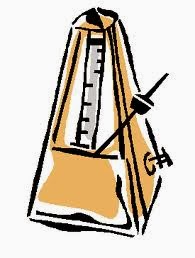
I teach an adult student who has been playing for about 11 months and has been making steady progress. Her movement from chord to chord is becoming more fluid, she has a couple "go to" strumming patterns that work in 90% of the songs she wants to play, and she has a natural affinity for fingerpicking. To help her move to the next stage of her playing, I've been preaching metronome work.

We had a good laugh today when she said, "The metronome messes me up."


Right now, my student has trouble strumming steady quarter notes along with a metronome set to 80 bmp. However, she can count out loud in time with the metronome, no problem. She can also tap her guitar in time with the metronome. After she counts out loud and taps, she is then able to strum to the metronome. So, that's the exercise…count with the metronome, tap with the metronome, and then strum with the metronome. I've given her one-bar combinations of quarter notes and eighth notes to play, but I've asked her to always start with the quarter note exercise.

This may sound like a remedial exercise, and I know for certain that my student doesn't enjoy this, but it's absolutely essential to develop a sense of rhythm and time. It's the only way you're going to play well with others. Even if you're a soloist, you're going to need to keep a steady beat, otherwise people will find it challenging to listen to you.

Whether you want to be a killer lead player or a rock solid rhythm player, practicing with a metronome is the most efficient way to improve your technique. Once you are able to maintain a steady beat and stay in sync with the metronome, you can make friends with difficult lines or chord changes more easily. First, you start the metronome at a tempo at which it is nearly impossible to make a mistake. It may be an excruciatingly slow tempo, but that's okay. You want to start super slow, so that you are properly training your muscle memory. Get it right in slow motion, and you can then incrementally get it right at speed. Just start at a nice, easy tempo. Practice a problem area until you can play it correctly. Increase the metronome speed by 5 clicks and repeat the process. You will eventually run into a speed at which your technique finally breaks down. Remember the top speed at which you could play with control. The next time you practice that spot, start 10-20 clicks slower than your top speed and build from there. It won't be long before you can sail through that lick or those tricky chord changes.

My student has told me that she has no rhythm. I beg to differ. She has an undeveloped sense of rhythm, but it's in her. All she needs is a metronome and a few minutes a day focusing specifically on tempo.

Monday, March 11, 2013

It's About Time

Keeping steady time is an important skill for any musician. It's a simple concept, but it's not as easy as you might think. Just ask anyone who plays with a metronome for the first time. You may think you are keeping a steady beat, but when you begin practicing with a metronome, you'll swear that the metronome is slowing down. It surely couldn't be that you are speeding up!

When I was a trombone player, I tried to stay on top of the beat. The trombone is a big instrument and requires a lot of air, making its response time a little slower than a smaller instrument like a trumpet. When I began playing guitar, I carried this "slightly ahead of the beat" mindset with me, which was a mistake. The guitar is much more responsive than a trombone, and by playing on top of the beat, I tended to rush.

With some effort, I've gotten my time under control…for the most part. When playing rhythm guitar, I can keep it nice and steady, but I tend to push the tempo when I'm improvising. My guitar teacher, Dave Frackenpohl, gave me a useful exercise.

My trusty old Dr. Beat.
The metronome never lies.
If you want to work on your own sense of time, first try practicing with a metronome ticking away on every beat. If the tempo is 120, then set the metronome at 120. You'll soon discover where you tend to rush.

Once you're used to playing with the metronome on every beat, set it to half the speed (in our case, set it at 60). Now think of every click of the metronome as beats 2 and 4, with beats 1 and 3 being silent. Without that steady click on every beat, you have to rely more on your own sense of time.

Finally, and this is the exercise Dave gave me, set the metronome to one quarter speed (in our example, we'll set it at 30). Now think of every click as beat 4, with beats 1 through 3 being silent. This suddenly becomes a much more challenging exercise!

Because I'm most likely to push the tempo while improvising, Dave has me improvising solo lines while setting the metronome to click just on beat 4. This gives me the double benefit of working on time and improvisational ideas at the same time. It only took me a couple days of this for my inner sense of time to settle down. I'm not saying that my time is suddenly perfect, but it has become more solid over the past couple weeks, and it'll only get better as I continue to work on it.

Saturday, May 14, 2011

How to Practice

I don't have an immense amount of natural musical talent. This is a realistic self assessment, not false modesty. Of course I have musical gifts, but there are plenty of other musicians who have way more talent than I have. We are all born with varying degrees of potential, but what's really important is that we learn to develop whatever gifts we have been given.

One thing that's helped me make it this far (and hopefully further!) is my approach to practicing. Talent alone will only take you so far. I know a few musicians who have an incredible amount of native talent, but their skill level has stalled out because they're relying on talent alone. They sound fine, but they don't seem willing to take their playing to the next level. If they would develop a consistent approach to practicing, they would sound incredible.

Here are some strategies that I use in my own practice sessions. Maybe they'll help you out, too.

  • Set aside a certain amount of time each day for practicing. Whether it's 30 minutes or 3 hours, dedicate that time period to the guitar (or whatever instrument) – no distractions. A little bit of time every day is better than a lot of time one day.
  • Always warm up. I start every practice session with some guitar exercises that stretch the fingers, and then I start to work on scales, arpeggios, and other patterns. Once I've finished working on my warm-up and technique exercises, I feel more ready to tackle new guitar arrangements or difficult music from a show book.
  • Focus. Start each practice session with a clear idea of what you want to accomplish. Maybe you want to learn a new scale pattern or get better at playing the new chords you just learned. If you have goals, you can keep your practice sessions more focused.
  • The pencil is your friend. Write reminders in your music. Even if you play your repertoire from memory, it's nice to have those reminders if you're practicing and you run into a memory block.
  • The metronome is your friend. Playing to a metronome is the best way to train yourself to keep a steady tempo. I probably spend 50% or more of my time practicing with a metronome.
  • Repeat, repeat, repeat. To master a new technique or lick, you need to play it over and over. If you play something wrong 5 times in a row but get it right on the 6th, don't stop there. Practice a lick until you can play it perfectly at least three times in a row.
  • Decide on some stopping points instead of running straight through a song. Try breaking a song up into 4 or 8 bar chunks. Stop after each phrase and evaluate. Did you miss a note? Could you have phrased something differently? Go back and practice that phrase again before moving on to the next phrase.
  • Practice backwards. We all naturally tend to practice a song from beginning to end. Sometimes the second half of the song gets less attention than the first half because of mental or physical fatigue. Try practicing the last four bars first and then work your way from back to front.
  • Practice the hard parts! It's more fun to practice the parts of the music that we're good at, and sometimes we neglect the tricky parts. Isolate the difficult spots and drill them over and over until they're easy.
  • Add a tricky part to your warm-up. If you have a difficult lick to play in a song, turn it into a pattern and play it in all keys during your warm-up. After a few days, this tricky spot won't feel difficult at all.
  • Practice slowly! (This is the practice technique that I use the most.) Use a metronome, and practice a difficult passage at a tempo at which it's almost impossible to make a mistake. After you can play it three times in a row with accuracy, speed up your metronome by 5 BMP (beats per minute), and practice the passage until you can play it accurately three times in a row. Eventually you'll reach a breaking point. Do this over the course of a week, and you'll be surprised at how much faster you can accurately play the same music. Accuracy is the key. Accuracy precedes speed. You improve your accuracy by developing muscle memory. Your speed will develop as your motor skills improve.
  • Practice your weaknesses until they become your strengths. Figure out what you're worst at, and practice it!
  • Record yourself. This can be a painful experience, especially the first time you hear yourself, but this is the absolute best way to evaluate yourself.
Knowing how to get the most out of your practice session is important, but don't forget to have fun! There is practicing music, and there is playing music. Don't forget to play. It's important to listen to yourself critically so that you can improve your skills, but it's also important to shut off that critical voice and just play for the joy making music, which is what got us musicians hooked on music in the first place.