About Me

My photo
Atlanta, GA, United States
When I suffered a lip injury that ended my career as a classical trombonist, I thought my life as a musician was finished, but I fell in love with music all over again when Santa gave me a guitar for Christmas in 2003. Even as I was struggling with my first chords, I was planning a new performance career. As a trombonist, I performed with the Heritage of America Band at Langley Air Force Base, the Ohio Light Opera, and in pick-up bands for touring acts that included Rosemary Clooney, George Burns, and the Manhattan Transfer. Reborn as a jazz guitarist, I sing and play my own solo arrangements of jazz classics, am half of the Godfrey and Guy duo, and hold the guitar chair in the Sentimental Journey Orchestra. I have been a freelance music copyist since 1995, served as Director of Music at Northwest Unitarian Universalist Congregation from 2011 to 2017, and currently serve as Contemporary Band Director at the same congregation.
Showing posts with label musical equipment. Show all posts

Sunday, February 5, 2012

Going High Tech

It's Superbowl Sunday, so of course I spent my evening recording some music.

A few months ago, I wrote about my mild case of G.A.S. (gear acquisition syndrome). Thanks to a very large music engraving project, I've been able to acquire some new goodies. Since I began taking piano lessons, I purchased a new keyboard, but that's the only instrument I bought. This time, I got my hands on some high tech goodies, starting with an iPad.

My iPad has quickly become an incredibly useful tool for making music. As soon a I purchased the iPad, I bought the DeepDish GigBook app. Over the past few years, my songbook has become pretty thick. After adding hundreds of pages, it's a major pain to carry my songbook to gigs. With GigBook, I can store all of my sheet music in my iPad. I've made it a habit to copy all my songs in Finale and save them as PDFs so that I can email music to other musicians. In addition to my own files, I also have PDFs of about 15 fake books. It turns out that I can export all of these PDFs directly to GigBook. Within minutes of installing GigBook, I literally transferred thousands of songs to my iPad. Now, instead of using a small backpack to tote my songbook, my music library fits in my guitar's gig bag.

What's even more amazing about GigBook is the ability to organize all my music. I've set up separate folders for my own songbook, Tea for Two, InTown Band, Unitarian Hymns, etc. You can also easily organize set lists, allowing you to scroll through the music, song by song, in set order. There are more ways to organize my music that I haven't even begun to explore. You can also write notes, by hand, directly onto the pages in GigBook, which is handy if you need to leave friendly reminders in the music.

The only downside to GigBook is that you can only see one page at a time – not that you'd want to try reading two pages side by side on the small iPad display. If a song is long enough, you're going to have to turn the virtual page, which is not so easy when both hands are busy playing guitar. Fortunately, there is the AirTurn BT-105. This is a rather unsexy name for a handy gadget. The AirTurn is a Bluetooth device that allows you to turn pages with your foot. Very cool.

Oh, but the fun doesn't stop there! I can record music with GarageBand for the iPad. There are some pretty good virtual instruments built in, including drums, various keyboards, basses etc. You can also play directly into the iPad thanks to iRig, and you can sing directly into the iPad with the iMic. While this app doesn't have all the features of ProTools or Cubase, it suits my modest needs, and I'm finding it quite easy to operate. I'm using iPad's GarageBand to help a friend record a vocal demo. I just laid down some backing tracks for her, and then I began recording a backing track of my own for one of my favorite tunes, Little Sunflower by Freddie Hubbard.

None of these high tech toys take the place of real musicianship, but they sure are useful…and they look cool. My G.A.S. is relieved…for now.

Saturday, June 19, 2010

A Mild Case of G.A.S.

Many guitarists have a bad case of G.A.S. – Guitar Acquisition Syndrome, sometimes known as Gear Acquisition Syndrome. If you want to rock out, you'll want an electric guitar, and many jazz guitarists (like me) like to play archtop guitars. For classical music, you'll need a classical nylon string guitar, and you'll need an acoustic guitar for folk music. And then there are the many, many cool guitar toys! Effects pedals, amps, and much more. Like many guitarists, I regularly look at guitar porn…catalogs from Sam Ash, Guitar Center, Sweetwater, and other music stores. I eagerly thumb through each catalog to see what's new, and I dog ear each page that has something I might "need."

My G.A.S. is relatively mild. I've never been a big gear nut, and I don't automatically buy every new thing that comes out – mostly because money is in short supply. If I suddenly found myself with a lot of money, I suspect my G.A.S. would worsen.

The rest of this blog is dedicated to the gear I use most often.

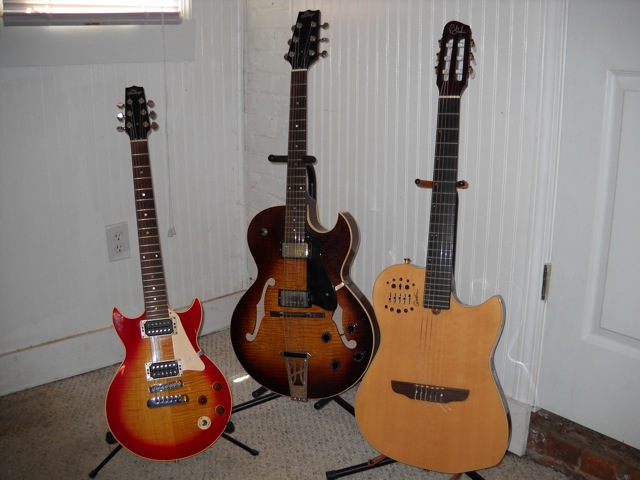
Guitars: From left to right, my three guitars are a Heritage 170CM, a Heritage 575, and a Godin Nylon SA.


The red Heritage 170 on the left is my newest and oldest guitar. I bought it less than a year ago at Earthshaking Music, so it's the newest guitar in the family, but the guitar is 25 years old. I can get a wide variety of sounds from this instrument, and it's perfect for the eclectic soul fusion of InTown Band. This little guitar is ridiculously easy to play.

The Heritage 575 in the middle is my main axe. It's beautiful to look at, and it's even more beautiful to hear. This jazz box has an incredibly sweet sound, and it's easy to play. I play this guitar with On the Cool Side, as a soloist, and as a rhythm guitar when I sub with the Atlanta Swing Orchestra and the Sentimental Journey Orchestra.

The Godin on the right is an electric nylon string guitar. Although it's electric, it has a very convincing classical sound. I often use the Godin for solo and duo settings. I just love the sound of finger style jazz arrangements played on a nylon string guitar. One really cool thing about this guitar is that it can be plugged into a synthesizer, which gives me access to a whole world of sounds, including strings, winds, and exotic instruments from all over the world.

Since I play all electric guitars, I need amps. My two main amps are the Roland Cube 60 and the Roland AC-90.

I use the Cube 60 for the two Heritage guitars. Although you can use the Cube 60's lead channel to get a variety of sounds, I only use this amp for the clean sound. (A clean sound in guitar-speak means the sound you get without any effects added.) It's absolutely perfect for jazz guitar, and it has reverb built right in. With the Heritage 575 (my jazz guitar), this may be the only amp I'll ever need.


The AC-90 is designed for acoustic guitars. This is what I use with the Godin nylon string, and it sounds pretty decent with the Heritage jazz box, too. The AC-90 has built in reverb, and it also has a separate input for a second instrument or a microphone. Most guitar amps sound terrible if you sing through them, but you can get a surprisingly good vocal sound out of the AC-90.


I don't have a wide array of effects pedals, but I use a few. When I play with InTown Band, I use the Boss ME-50 multi-effects pedal. I use the small pedal on the left to add distortion. I use the small pedal in the middle if I want to add a tremolo sound, and the small pedal on the right is for a delay effect (an echo effect). I use the big pedal on the right for a wah-wah sound.


And finally, we have a Boss chorus pedal and a tuner pedal. I love this little blue chorus pedal. If I get the settings just right, I can create a transparent, glassy tone that sounds great with many of InTown Band's mellower songs. The Boss TU-2 tuner is always in my gear bag. First of all, it's an excellent tuner, but it has side benefit. When you step on the pedal to turn it on, it mutes the guitar sound, so the audience doesn't have to listen to you tune. This comes in handy when I play in church at NWUUC. If a string goes out of tune during the service, I can quietly retune without bothering the congregation.


That's about it. Compared to your average folk guitarist, I suppose I have a lot of gear, but this is nothing compared to what many rock guitarists might use. I like to keep my rig simple, and aside from InTown Band's music, the only effect I use regularly is a touch of reverb.